
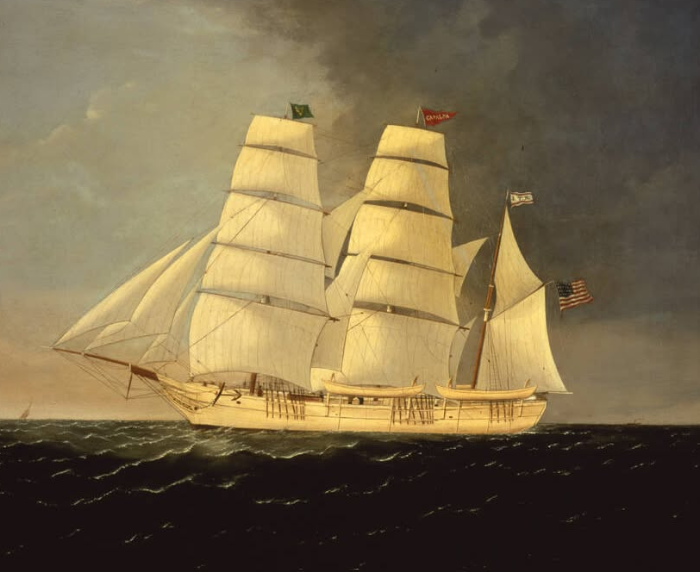
On the morning of April 29, 1875, the bark Catalpa sailed from New Bedford Harbor looking much like another whaleship beginning a long voyage. Her captain, George S. Anthony, was an experienced New Bedford whaleman, and the vessel had been properly fitted and supplied for months at sea. Yet the Catalpa was beginning a voyage unlike any ordinary whaling expedition. Her secret mission would eventually take her halfway around the world to help rescue six Irish prisoners from British custody in Western Australia.
A Daring Plan
The story began with the Fenians, members of the Irish Republican Brotherhood who sought an independent Ireland. More than sixty Fenian prisoners were transported aboard the Hougoumont to Western Australia, arriving in 1868. Many were eventually pardoned or released, but several military Fenians remained imprisoned. One of them, James Wilson, secretly appealed to fellow Fenian John Devoy in America, asking his former comrades not to forget the men still held in Australia.
Devoy and other supporters began planning an extraordinary rescue. They were aided by the experience of John Boyle O’Reilly, a former Fenian prisoner who had escaped Western Australia in 1869 with assistance connected to an American whaleship and later settled in Boston. His escape helped demonstrate how a whaling vessel could reach the remote Australian coast without necessarily attracting unusual attention. The organizers decided they needed a ship of their own.
They found the Catalpa.
New Bedford Joins the Story
In March 1875, the Catalpa, a three-masted bark of approximately 202 tons, was brought to New Bedford and prepared for the voyage. Connections within the city’s maritime community led the organizers to Captain Anthony, who agreed to undertake the mission. Under his direction, the vessel was fitted at New Bedford’s City Wharf, supplied for an extended voyage, and equipped for whaling.
The Catalpa actually conducted whaling operations as she traveled. An early account of the expedition records that the vessel collected 210 barrels of sperm oil before continuing on the long journey toward Australia. Nearly a year after leaving New Bedford, Anthony reached Western Australian waters in March 1876.
The Escape
While Anthony crossed the oceans, agents John J. Breslin and Thomas Desmond were quietly preparing the escape on land. On Easter Monday, April 17, 1876, six prisoners, Thomas Darragh, Martin Hogan, Michael Harrington, Thomas Hassett, Robert Cranston, and James Wilson, slipped away from their work parties and were rushed toward the coast at Rockingham.
Captain Anthony was waiting offshore with a whaleboat from the Catalpa. The prisoners reached the boat, but difficult weather prevented the group from immediately returning to the ship. After enduring dangerous conditions at sea, the escapees finally reached the Catalpa. British colonial authorities soon sent the steamer Georgette in pursuit.
Under the American Flag
On April 19, the Georgette confronted the Catalpa and attempted to compel Anthony to surrender the escaped prisoners. Accounts describe a warning shot being fired as the authorities demanded that the vessel stop.
Anthony refused. The Catalpa had reached international waters and was sailing under the American flag. Anthony asserted the protection of his country’s flag and his vessel’s position on the high seas. Seizing the ship there risked creating an international confrontation, and the Georgette ultimately abandoned the pursuit.
The six prisoners were free.
Home to New Bedford
After crossing the oceans once again, the Catalpa returned to the United States. The rescued men arrived in New York in August 1876, where their escape was celebrated by supporters. The vessel then continued home, arriving in New Bedford on August 24, 1876. Accounts describe a large crowd gathering along the waterfront to welcome Captain Anthony and the ship back into port.
The Catalpa rescue remains an important chapter in Irish and Irish American history, but it is also part of New Bedford’s maritime story. The expedition relied upon the skills developed through the city’s whaling industry: navigating vast distances, maintaining a sailing vessel for months at sea, handling small whaleboats in dangerous conditions, and operating thousands of miles from home.
The Catalpa had been prepared on New Bedford’s waterfront, commanded by a New Bedford whaleman, and returned here when the mission was complete. Her extraordinary voyage reminds us just how far the people, ships, and maritime knowledge of this historic port once reached.
The Catalpa left New Bedford as a whaleship. She returned as the vessel that had carried six men to freedom.
See the front desk to inquire about getting a print of the Catalpa today!